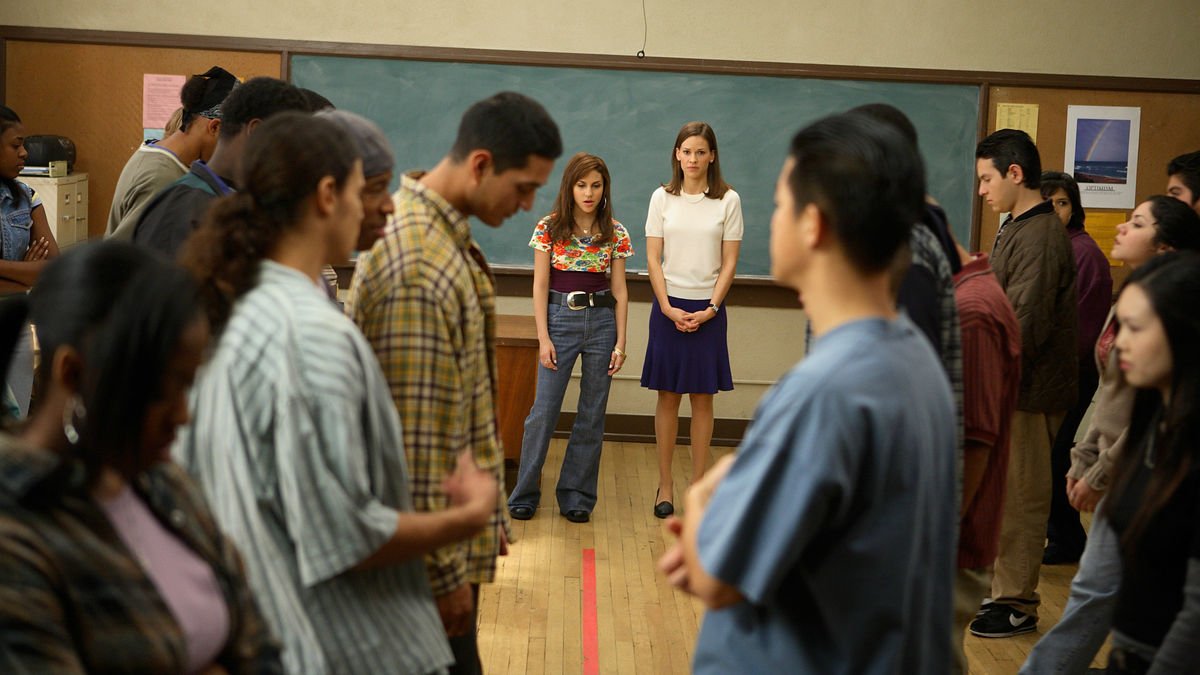
There are films that entertain, and there are films that awaken something deep within us — a forgotten belief in the power of education, empathy, and the human spirit. Freedom Writers (2007), directed by Richard LaGravenese and based on the true story of Erin Gruwell, is one such film. It does not dazzle with grand gestures or sentimental heroism; instead, it moves us quietly, showing how one teacher’s unwavering belief in her students can change the course of their lives.
Set in Long Beach, California, in the aftermath of the 1992 Los Angeles riots, the film introduces us to a classroom fractured by race, poverty, and violence. The students are divided into gangs — Black, Latino, Asian — and see school as yet another system that has failed them. Into this volatile environment steps Erin Gruwell (played with luminous sincerity by Hilary Swank), a young, idealistic English teacher who refuses to accept that her students are beyond hope.
At first, the students mock her enthusiasm and reject her lessons. They are tired of being judged, stereotyped, and written off. But Gruwell does something radical — she listens. She replaces rigid lesson plans with conversations that honour their experiences. She hands out cheap composition notebooks and asks her students to write their stories, honestly and fearlessly. What emerges from those pages is a chorus of raw, unfiltered voices — of pain, survival, and an aching desire to be seen.
Those diaries, later published as The Freedom Writers Diary, become the heart of the film. Through writing, the students begin to heal. Through reading stories of others who suffered — particularly the diaries of Anne Frank and the testimonies of Holocaust survivors — they learn empathy and the courage to imagine a future different from their present.
What makes Freedom Writers extraordinary is not just its narrative of redemption, but its portrayal of teaching as an act of moral imagination and creative engagement. Erin Gruwell’s classroom becomes a sanctuary — not because it is equipped with technology or resources, but because it is filled with trust. She challenges her students to think, to feel, and to believe that their words matter. The classroom, once a site of alienation, turns into a community of equals where difference is not feared but celebrated.
The film does not shy away from showing Gruwell’s struggles. She faces scepticism from colleagues, lack of administrative support, and the slow erosion of her personal life. Yet her persistence reminds us that education, at its best, is sustained not by policy but by conviction — by the teacher’s faith in the transformative potential of every learner.
For educators, Freedom Writers is not just inspiring; it is instructive. It demonstrates how dialogue, storytelling, and emotional safety can unlock learning in classrooms fractured by inequality — a truth equally relevant in Indian classrooms where diversity, caste, and economic disparity shape children’s experiences. Gruwell’s approach echoes the ideals of inclusive education: meeting learners where they are, valuing their realities, and using pedagogy as a bridge between the personal and the academic.
Visually, the film is understated yet powerful. The handheld camera work mirrors the intimacy of the classroom, the faces of the students glowing with vulnerability and defiance. The soundtrack, layered with soulful hip-hop and quiet piano notes, amplifies the film’s emotional pulse without overshadowing it.
Beyond its moving story of transformation, Freedom Writers is a quiet celebration of what creative pedagogy can achieve. It reminds us that learning becomes powerful when it connects with the learner’s world — their language, emotions, and lived experiences. Erin Gruwell’s success lay not in exceptional resources or privilege, but in her ability to make education meaningful, personal, and joyful.
This message holds deep resonance for Indian classrooms, where diversity is both a gift and a challenge. Children come from a wide range of linguistic, economic, and cultural backgrounds, each carrying unique stories and strengths. Often, these differences can become invisible or even divisive in a rigid, exam-driven environment. Freedom Writers reminds us that the classroom can instead become a place where creativity bridges these differences — through storytelling, project-based learning, reflective writing, and collaboration.
The film affirms that a teacher’s greatest resource is not technology or infrastructure, but imagination, empathy, and trust. By inviting students to express themselves freely and by connecting curriculum to real life, teachers can awaken curiosity and confidence even in the most hesitant learners. This approach turns learning into an act of discovery, not duty — and classrooms into spaces of warmth, not competition.
In the end, Freedom Writers is less about one teacher’s triumph and more about the timeless truth that education flourishes when it touches the heart as well as the mind. In a world that often celebrates outcomes over understanding, this film gently reminds us that the most creative pedagogy is that which restores meaning, belonging, and joy to the act of learning.
M. Artiage is an independent writer. He is based in Sydney.