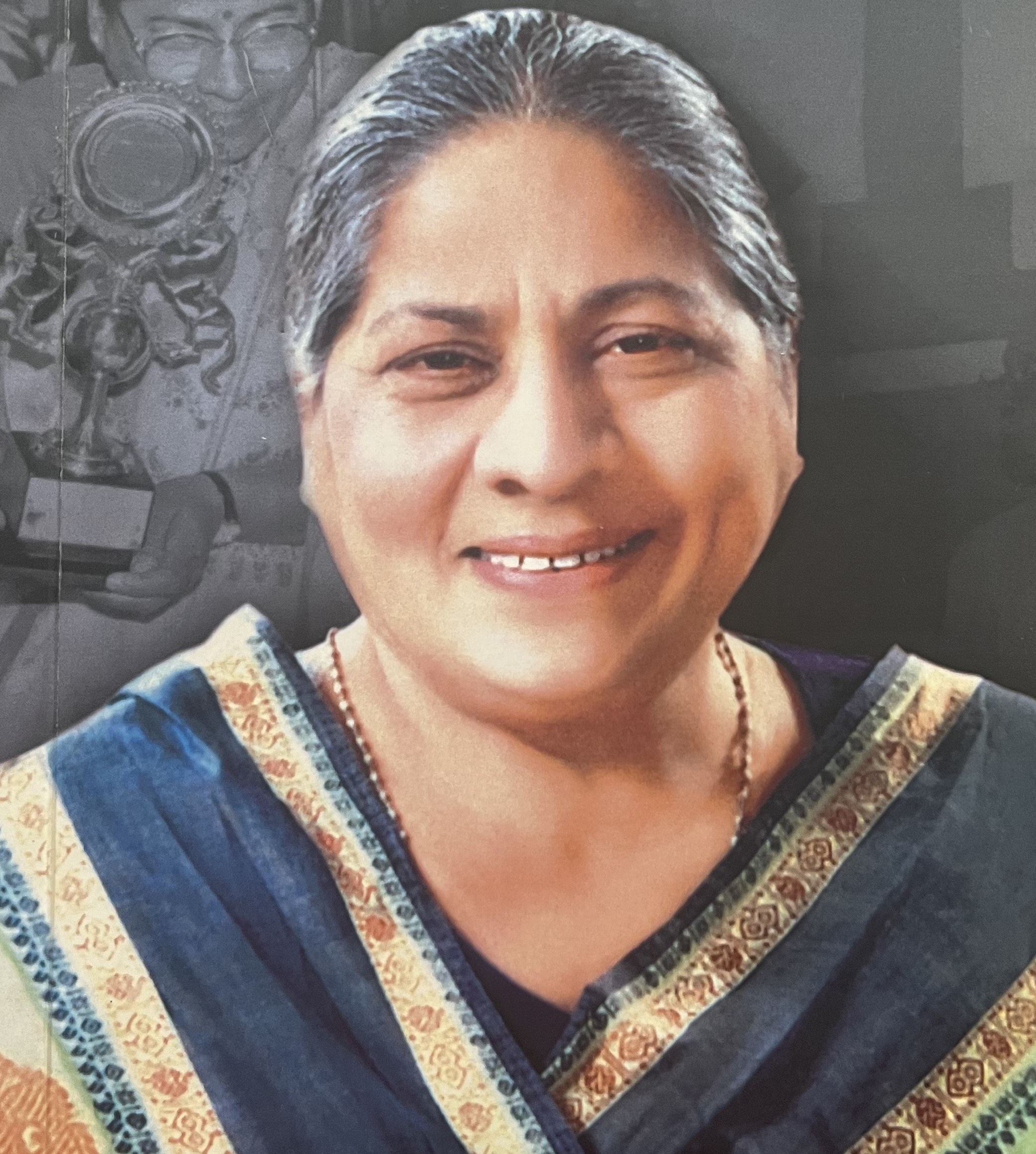
A tribute often paid to social activists is of their lifelong commitment. It is rare to find someone who got involved with social commitments in middle age and then very quickly established a reputation for complete honesty and limitless courage. This would be even more unexpected for a woman who had hitherto been confined mainly to family responsibilities in a middle-class Delhi household. However, this is precisely what Nirmala Sharma achieved in Delhi, starting around 1991 at the age of 44 and continuing for about 25 years till her tragic death in the middle of several struggles.
Nirmala Sharma formed an organization called Jagriti Mahila Samiti (JSM or Committee for the Social Awakening of Women), which soon acquired a well-deserved reputation for taking up the cause of several distressed women in highly determined ways. Nirmala did not step back from helping these women even when she was personally beaten up by the oppressors of these women who had escaped law by paying bribes. She faced these oppressors and corrupt officials with courage right inside their homes, police stations, and courts, fighting long legal battles in very adverse conditions.
As the reputation of her efforts spread fast, she was invited by one of the most well-established women’s organizations to be a part of a function in memory of women victims, organized in collaboration with police. After homage and speeches were done, the meeting was announced to be over. Nirmala was on her feet, protesting that more should be discussed and done. She wanted to examine all the cases of women victims mentioned here to see in how many cases justice had been done and the culprits were punished. Within a few days, she was involved in protests leading to her personal victimization when she took forward such issues on the streets.
She widened the horizons of women’s issues to get seriously and deeply involved in several efforts of getting relief for victims of slum demolitions and evictions of hawkers. Although these were very difficult struggles, several times she and her colleagues succeeded in getting significant relief for victims. She was also involved very deeply in the anti-liquor movement, and while most local people were afraid of the liquor mafias that were very active in many slums, she, along with her colleagues, personally raided the illegal storage places of these liquor mafias several times.
While taking up all these courageous activities, Nirmala continued to take good care of her family. A deeply religious person, several times when I went to meet her early in the morning, she was busy in her puja (worship). She derived strength from religion to keep alive her struggles to help the poorest people and highly distressed women. Although she came from a Brahmin family, she was in the forefront of helping Dalits, and her closest colleague was a Muslim woman Durdana Khan, who too shared the beatings and insults Nirmala Sharma received in the course of her struggles.
Nirmala, Durdana, and other colleagues did not hesitate to go to those places where there was a chance that they might be assaulted or hurt. From where did Nirmala, who had hardly ever seen a struggle before the age of 44, get this strength suddenly to be in the middle of several such struggles simultaneously? Nirmala’s elderly uncle was a freedom fighter. Her father, Pandit Hotilal, was a scholarly person who had so impressed the leading industrialist for whom he worked that the industrialist was keen to get his own children educated by him. Hotilal agreed but at the same time continued to find the time to teach children from poor families, not accepting any honorarium from either the top industrialist or from the poor households. At the same time, he mobilized the workers to raise demands for better facilities for their colony, something the industrialist had to accept.
So probably the seeds of sensitivity to the problems of the distressed and the poor were already there in Nirmala, but the person who should get the most credit for launching Nirmala on the path of social movements was her husband, Amarnath Sharma. An academic, he had annoyed his seniors by mobilizing the workers of the institute where he worked. A substantial part of his salary was spent on helping others in need. He was all the time encouraging Nirmala to do something for distressed people and particularly for women in a selfless way, but without joining any political party or electoral politics. He was the real mentor of Nirmala the social activist, but unfortunately, he died from cancer in 1996. This was the biggest shock of her life for Nirmala, but her struggles continued. After some years, Nirmala’s eldest son too died from cancer. The fact that she could continue her work involving struggles on an almost daily basis in the middle of such personal setbacks speaks enormously for her very deep social commitments.
As a journalist who reported on her struggles in newspapers and also brought out supportive booklets, I met Nirmala Ji several times, and she always impressed me with how deeply she cared for the people for whom she was working.
The growing fame of JMS as an honest and dedicated organization led to people from outside Delhi also approaching this organization for intervention in cases relating to atrocities against women. Nirmala Sharma went to investigate and/or settle several serious cases such as those in Kalota (Rajasthan), Hullaheri (Haryana), and Ferozepur (Punjab).
JMS succeeded in preventing evictions in several places like Rajiv Gandhi Camp (Punjabi Bagh), Madipur, Pitampura, etc. In Raghubir Nagar old F Block, JMS fought one of its most bitter battles to save the huts of nearly 4000 families… In this struggle, Nirmala Sharma and her closest colleague Durdana Khan were beaten up badly. Although they could not save the huts from demolition, they continued the struggle for getting all the necessary facilities at the resettlement site in Bakkarwala.
Bharat Dogra is a is Honorary Convener, Campaign to Save Earth Now. His recent books include When the Two Streams Met (freedom movement), A Day in 2071, Man our Machine and Planet in Peril.