The Vegetarian is written in a soft, gentle register that does not leave you even when Han Kang makes you confront the brutal indifference and violence that mark our times. We are indeed living in times marked by everyday brutality, but how do we speak about these forms of violence before we hastily try to fix them is a question that this book left me with. This work is about abandonment, disposable lives, and the subtler as well as explicit violence that runs deep in our everyday lives, but the prowess of Han Kang’s words lies in revealing these forms without leaving the reader alone, resentful, or angry. Instead, she opens an empty space, inviting us to grieve and mourn with her.
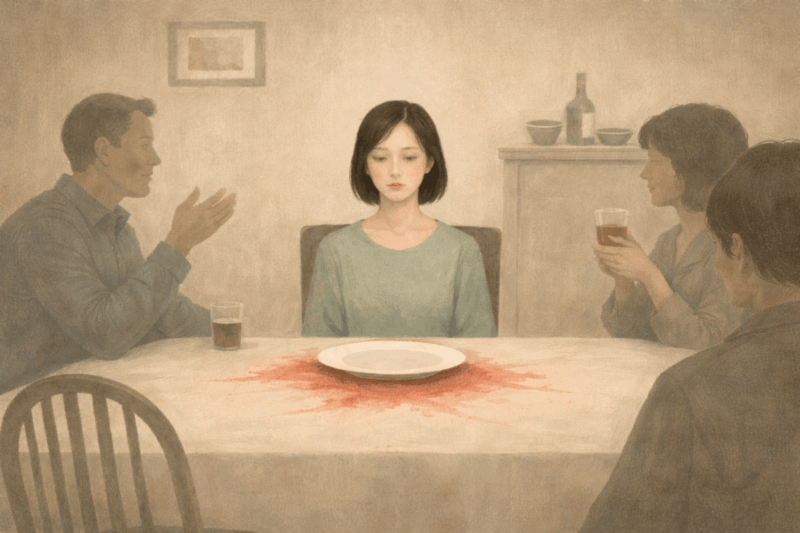
Han Kang demonstrates an indifference that is not distant in nature, but one that is present within close, intimate relations. This comes through starkly when Yeong-hye, an ordinary South Korean housewife, gives up meat following disturbing dreams of blood and slaughter. This seemingly simple decision shakes the semblance of her normal married life and is met with violence by those around her. It does not take long for her to become an outcast—to her husband, her parents, and her siblings—who demand the return of an earlier normalcy. Within a short span of time, she is divorced and institutionalized. The indifference of the family can be experienced not only in the moment when her father slaps her, forcing meat down her throat, but even more so in moments when they become impervious to understanding her, impatient with her decisions, and opaque to the life she is experiencing. In their refusal to be witnesses to her choices and her life, they deny her the recognition that stands central to being human.
Yeong-hye possesses a sensitivity that allows her to feel blood on her fingers and to recognize how she has participated in killing lives—animals, in this case. Her refusal to eat meat becomes her silent resilience against a life that demands killing. Giving up meat, and eventually food itself, becomes her form of redemption, the way she atones for the violence being enacted around her.
Han Kang captures something deeply disturbing about our times through an interplay of life and death, which reminded me of Agamben’s Homo Sacer—lives that can be killed but not sacrificed. Apparent normalcy comes at the cost of many lives that are quietly extinguished. This killing does not occur in a single, brutal strike, but in the ordinariness of everyday life. Unlike sacrifice, these deaths are neither recognized nor granted dignity. Instead, they are maintained at the threshold of life and death: not allowed to live fully, yet not allowed to die. This paradox is condensed in the word killing—a denial of life as well as a denial of death. Such lives are not permitted to live, nor are they allowed the release of death. Like text marked by the strikethrough feature in Microsoft Word, they exist, but their existence has been crossed out, defining an in-betweenness, a threshold where they remain suspended. Yeong-hye is stuck on that threshold—as a stricken-through life.
Han Kang gently reveals our complicity in allowing lives around us to remain trapped on this threshold. This becomes evident in an ordinary yet unsettling moment when Yeong-hye’s successful, calm, and composed elder sister, In-hye, reflecting on their childhood, wonders how—without Yeong-hye—the violence within the family might have been directed towards her instead. By absorbing that violence, had Yeong-hye not enabled her sister to carve out a stable life for herself? Does every family not have a Yeong-hye—someone whose fabric is punctured every day, denied both life and death, laying the foundation for others to live upon? Do our cities not thrive by maintaining marginal lives on this very threshold? Is our world not moving in a direction where refugees and minorities are continually abandoned?
Yet, instead of surrendering to the bleakness of our times, Han Kang opens a register of melancholia where sharing becomes possible. This is visible when the elder sister participates in and bears witness to the life of her dying sister. She may not understand Yeong-hye’s motives—something to which we as a human race attach excessive importance—but she does make herself a witness to what Yeong-hye is experiencing. It is this quiet, soothing presence that Han Kang offers her readers while rendering visible the layered abandonments that define our lives.